
Yesterday was November the fifth, personally my favourite holiday in the UK and we have a tradition in my house of watching the criminally underrated gem of a film V for Vendetta. We watched it last night and I had abit of an epiphany , why are all dystopian futures portrayed with right wing governments being the bad guys?
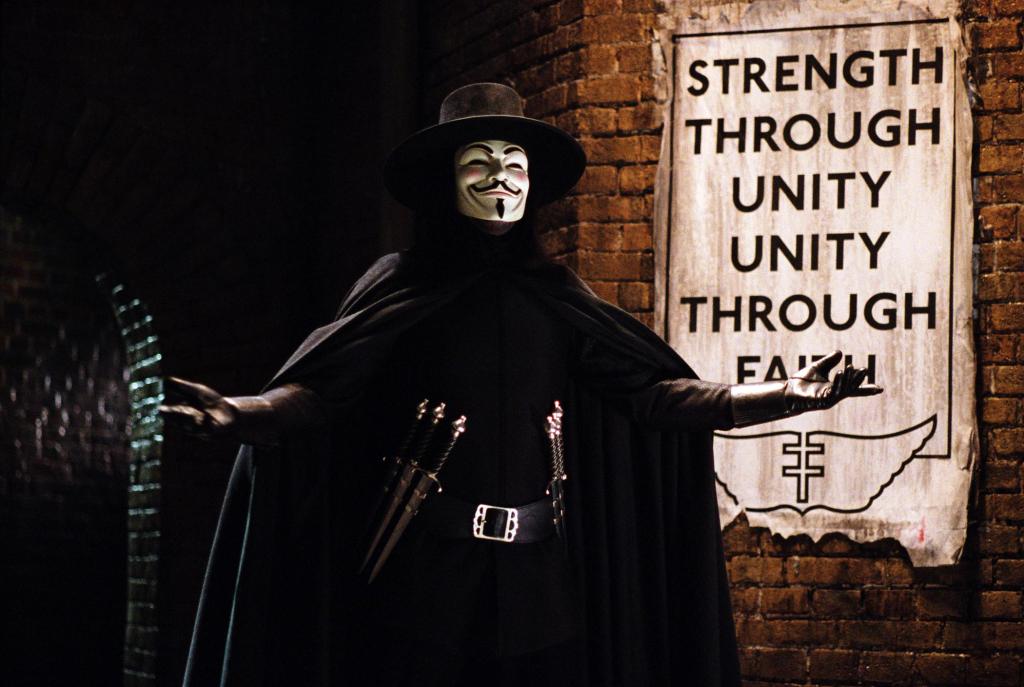
Dont get me wrong far right wing governments have done terrible things in the past(and currently) but so have far left governments yet they are not nearly as well represented in popular media. Given the main tropes of what these governments are doing in these films I find myself looking at the real world and seeing most of the issues being championed by the left and not the right.
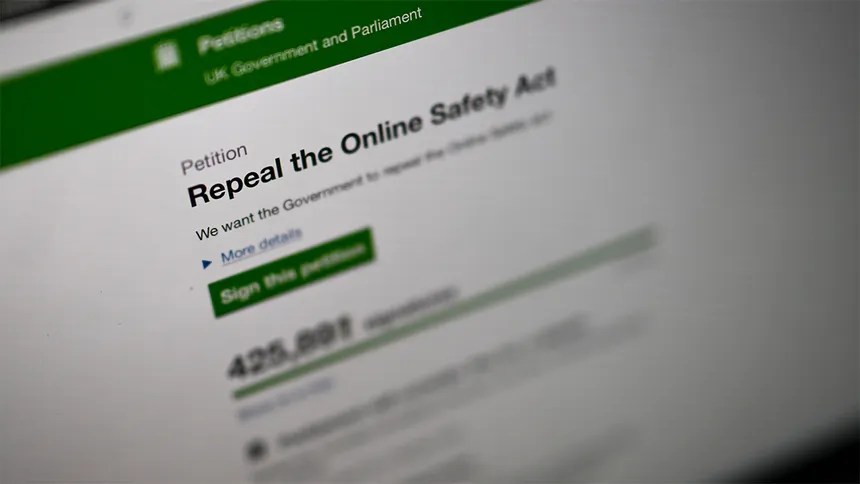
I talk about surveillance for one, an issue very close to my heart and its left wing companies that are stealing data and writing terms and conditions that give them the ability to read your emails, look at your photos and track your phone everywhere. Freedom of movement is another however this is abit more nuanced. The right are happy for people to travel almost anywhere they like but just with the right documentation and its the left who are using climate change as an excuse to bring things like carbon tax’s and carbon allowances into the mainstream(used up your carbon allowance this year well you better cancel that family holiday)
The dystopian genre has long been a mirror, reflecting the fears and anxieties of its time. Whether it’s the oppressive surveillance state of Orwell’s “1984” or the theocratic regime of Atwood’s “The Handmaid’s Tale,” dystopian narratives often feature right-wing authoritarian governments. This portrayal is perhaps rooted in the historical context of the 20th century, where right-wing totalitarian regimes left a permanent scar on the global psyche. However, the dynamics of political ideology are neither static nor confined to the patterns of the past. In the fabric of contemporary political discourse, there is an increasing conjecture that the next dystopian government might not rise from the right, but from the left. Here, we explore why a future dystopian government could be left-wing rather than right-wing.
The Cycle of Ideological Extremism
Political ideologies tend to operate in cycles, reacting against what they perceive as the predominant threats to society. As the world confronts complex challenges like climate change, wealth inequality, and disruptive technological advances, solutions proposed by the left are gaining traction. In such a scenario, the pendulum could swing to an extreme, where measures become draconically rigid and freedom is curtailed in the name of the greater good. A left-wing dystopia could emerge from an overzealous attempt to rectify societal imbalances, leading to overregulation, stifling of individual initiative, and a homogenization of thought in the name of equality and communal harmony.
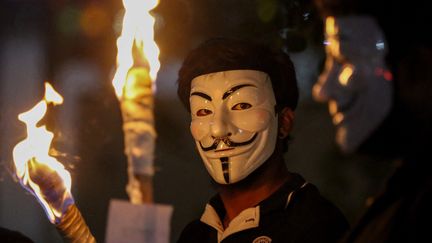
The idea of social imbalance is at the heart of most left wingers with equality in law now enshrined in much of the west we are now told its about equity, not equality so under represented races must now be given preferential admission to some jobs and schools. Agree with it or not this is a very slippery slope and inherently leads to conflict when someone is chosen for a job or a scholarship based solely on race rather than merit.
The Red Haze of Utopian Visions
The road to dystopia is often paved with utopian intentions. The left-wing ideologies, with their core emphasis on creating a just society where resources are distributed equitably, could become fertile ground for a dystopian government if they morph into a form of totalitarianism. In the pursuit of a perfect society, a left-wing regime could impose stringent controls on the economy, suppress dissent, and curtail freedoms, all under the banner of creating an egalitarian utopia. History has seen glimpses of this in various socialist and communist regimes, where the vision of equality justified the means, however draconian they might have been.
Technological Totalitarianism and Collectivism
With the advent of advanced technology, a left-wing dystopian government could harness data and AI to control and surveil populations under the pretext of collective welfare. The rationale would be the optimization of resources and the prevention of societal harm, but the underlying reality could be an intrusive state that monitors every aspect of life. Personal privacy could be deemed a sacrifice necessary for the greater good of society, leading to a scenario where the state intrudes into the most intimate corners of individual existence.
The Specter of Environmental Despotism
Climate change is arguably the existential threat of our time, and left-wing politics are at the forefront of advocating for drastic measures to combat it. However, in a dystopian future, this could transmute into a form of environmental despotism. Under the guise of saving the planet, a left-wing government could enforce extreme environmental policies that impinge on personal freedoms and property rights, establish strict population controls, and limit movement and consumption, all enforced by a powerful and unyielding bureaucratic apparatus.
We are starting to see far left policy proposals for carbon taxes and carbon allowance’s that will hit real working people incredibly hard. How would you feel working 40 hours a week to save for a family holiday somewhere warm and sunny just to be told you’ve exceeded your carbon allowance for that year and cant travel.

The Economy of Scarcity
Economic models based on central planning and extensive public ownership, often associated with left-wing ideologies, could also contribute to a dystopian reality. As seen in the past, such systems can lead to inefficiency, scarcity, and the breakdown of innovation. In response to these crises, a left-wing government could double down on authoritarian measures, leading to a society where the state becomes the arbiter of who gets what, when, and how, resulting in a loss of personal agency and freedom.
Conclusion
The specter of a left-wing dystopian government is not a prediction but a theoretical exploration of how extremes of any ideology can lead to oppressive outcomes. It is vital for democratic institutions and civil societies to remain vigilant and to ensure that the pursuit of equity does not lead to the erosion of liberty. The balance between collective welfare and individual rights is delicate and must be navigated with caution, as history has shown that the descent into dystopia can begin with the most noble of intentions. The future, therefore, does not inevitably belong to a left-wing dystopia; rather, it hinges on the choices, awareness, and resilience of societies as they strive to protect the principles of freedom, justice, and democracy.


 V3ndta Cybersecurity
Leave a comment